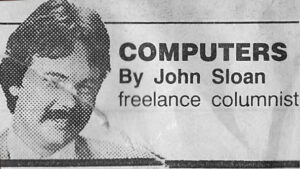
A surviving clip of my byline that didn't survive contact with a grandchild.
Because of an aversion to math and a budding interest in writing, Sloan changed his focus from science to the arts by the end of high school. He also developed an interest in journalism. His first published pieces were in the Gazette, Western’s student newspaper. In 1986 he entered the Graduate School of Journalism at Western.
After graduate school, Sloan worked for five months as a reporter for the business section of the London Free Press. During this time, he developed a focus on personal computing and created a weekly column on office technology. He would continue the column as a freelancer for the next 13 years. From the London Free Press, Sloan went to Western News, the internal
community newspaper of the University of Western Ontario.
At Western News, Sloan would write on a broad range of issues, from research projects, to student, staff, and faculty affairs, to campus politics, to administrative initiatives, and even the occasional crime and sports stories. Meanwhile, he continued his freelance efforts. Besides his Free Press columns, he also did the occasional piece for other publications.
For example, he was invited to write a piece on electronic writing tools for Canadian Author and Bookman in the early 90s. He had a short story published in one of the first “ezines” on the Web. (“Up in Smoke”, InterText. V4N2, http://intertext.com/magazine/v4n2/smoke.html). At a future university where students attend high definition video lectures and all carry their own portable computers, an aged professor finds out that he is redundant when he discovers that his video lectures are digitally generated, and his e-mail is being written by an AI avatar. Fairly prescient considering the story was written more than 30 years ago.
In the later 90s, Sloan left Western News, but he remained at Western for 4 more years to work primarily on developing the University’s Web site. He was convinced that the future for print journalism—as well as most communication, entertainment, and education—was in the digital realm. Toward the end of the decade Sloan was also a contributing columnist for Content London, a local culture magazine.
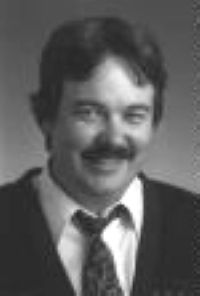
These were the cheesy mustache years.

Twenty years as an information technology analyst can age a person.
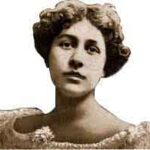
Emily Chesley, the sweet speculationist of the Southwest
In the count-down to the Millenium, Sloan focused on bringing his ‘day job’ and his sideline in technology journalism together. That process was completed at the end of the decade when he began a 20-year stint as a technology research analyst for the Info-Tech Research Group in London. As such he wrote white papers, research notes, instructional materials, and even columns (Processor Magazine 2009-2010). His research focus began with mass data storage and progressed through computer virtualization and then Cloud Computing.
At the turn of the century, Sloan was also a founding member of a satirical group called the Emily Chesley Reading Circle. Over the years he contributed to a rich Web site dedicated to Emily Chesley, the greatest Victorian era woman speculative fiction writer that there never was. The Circle also published a journal based on the Web site, The Meanderings of the Emily Chesley Reading Circle (2003).
In 2023, after more than two decades as an analyst and after the passing of his beloved wife, Marg, Sloan retired from Info-Tech Research Group. But he is still writing (see the Home Page). He continues to live in London, Ontario, in neither a rambling Victorian house nor a cozy flat. He does not own a cat.